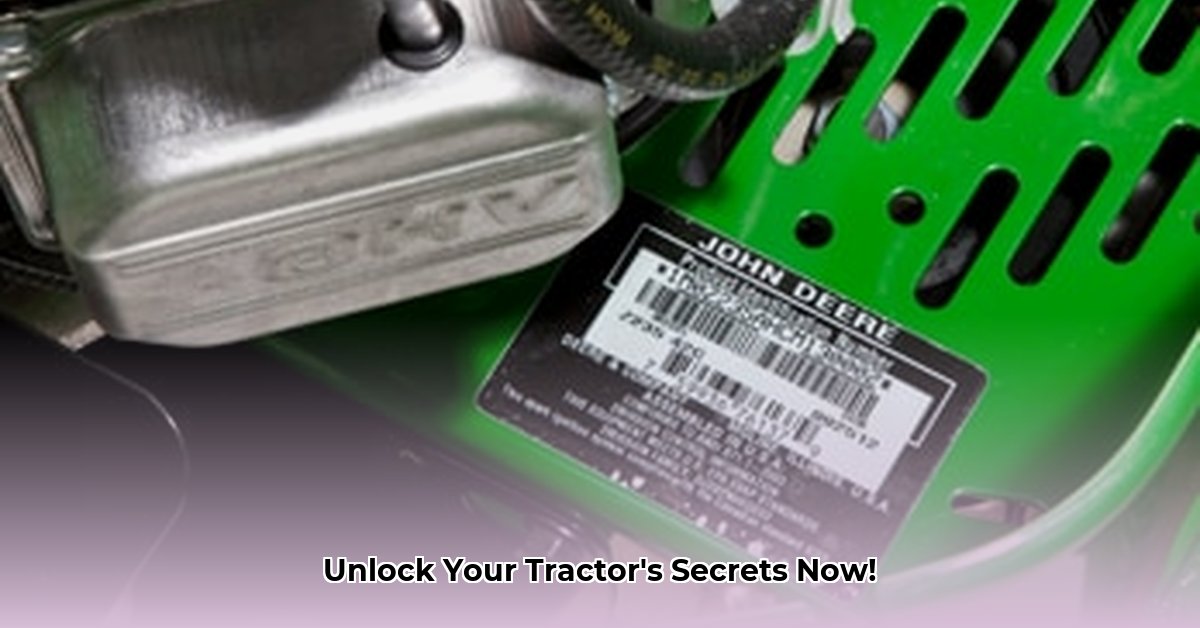
Your John Deere tractor's Vehicle Identification Number (VIN) is a unique identifier containing crucial information about its history and specifications. This guide provides a step-by-step process to decode your tractor's VIN, enabling better maintenance, parts ordering, and overall ownership. For more on John Deere tracked tractors, check out this helpful resource: tracked tractor info.
Understanding John Deere VIN Structures
John Deere tractors utilize VINs in two primary formats: 13-character and 17-character. Older models often have 13-character VINs, while newer models typically use the 17-character version. The longer VIN provides more detailed information. However, complete decoding of all characters often requires access to internal John Deere databases. This guide focuses on the readily accessible information.
| VIN Length | Character Position | Potential Information | Likely Meaning | Notes |
|---|---|---|---|---|
| 13 or 17 | 1-3 | Manufacturer's Code (John Deere) | Identifies the manufacturer as John Deere | Consistent across all John Deere tractors. |
| 17 | 4 | Model Year | Potentially indicates the manufacturing year | Not always reliable; requires cross-referencing with other data. |
| 13 or 17 | 5-8 | Model Information | Details about the specific tractor model | Varies greatly; includes model number, and possibly sub-model details. |
| 17 | 9 | Assembly Plant Code | Indicates the manufacturing location of the tractor | Identifies the John Deere factory where the tractor was built. |
| 17 | 10 | Model Year | Often, but not always, indicates the year of manufacture | Requires cross-referencing with other VIN data or official John Deere records. |
| 13 or 17 | 11-17 (13) or 11-17 (17) | Serial Number | A unique identifier for your specific tractor | Distinguishes your tractor from all others. |
How to Find and Decode Your John Deere Tractor VIN
Step 1: Locate the VIN Plate
Carefully inspect your tractor. The VIN plate is typically a small metal plate affixed to the tractor's frame near the dashboard, engine compartment, or under the seat. Thorough cleaning might be necessary for visibility.
Step 2: Accurately Record the VIN
Once located, meticulously transcribe the VIN. Double-check for accuracy. Even a single incorrect character can hinder the decoding process. Consider photographing the VIN plate for reference.
Step 3: Utilize Online VIN Decoders
Several reputable online resources provide VIN decoding services. Enter your accurately recorded VIN and compare the results across multiple websites. Discrepancies might occur; this is common.
Step 4: Verify with Official Sources
For the most accurate information, consult your John Deere dealer or the official John Deere website. These sources offer the most reliable decoding and information about your specific tractor. Is it worth the extra effort to ensure accuracy? Absolutely.
Interpreting the Decoded Information
The decoded VIN reveals vital information:
Manufacturing Year: Essential for scheduling preventative maintenance and repairs based on the manufacturer's recommendations. Do you know when your last major service was?
Model Number: Crucial for ordering the correct replacement parts and accessing specific repair manuals. Avoiding incorrect parts saves time, money, and potential damage.
Manufacturing Location: While not always critical, it might be helpful in sourcing parts from regional suppliers. Could this potentially reduce shipping times and costs?
Using Your VIN Information
Your tractor's VIN serves practical purposes:
Preventative Maintenance: Access manufacturer-recommended maintenance schedules tailored to your tractor's model year and specifications. Regular maintenance extends your tractor’s lifespan and prevents costly repairs.
Parts Ordering: Use the precise model information to avoid ordering incorrect parts; this is especially crucial during emergency repairs. Have you ever experienced the frustration of an incorrect part?
Resale Value: A complete understanding of your tractor's history, as revealed by the VIN, positively influences its resale value. A well-maintained tractor with a clear history generally commands a higher price.
Troubleshooting Common Issues
Illegible VIN: If the VIN is damaged or obscured, carefully clean the plate. If still unreadable, contact your John Deere dealer for assistance.
Conflicting Decoder Results: Discrepancies between online decoders are possible. Consult official John Deere resources to resolve any substantial differences.
Conclusion
Decoding your John Deere tractor's VIN is a valuable skill. It empowers you to make informed decisions about maintenance, parts ordering, and overall tractor management, ultimately extending its lifespan and maximizing its value. Remember to always verify your findings with trusted sources.